
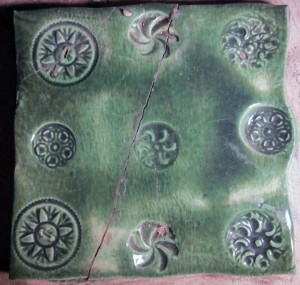
The Art Teacher handed out a damp clay squares and baskets of buttons and said to press them in any way we liked. I remember doing this: My seven-year-old mind was trying for a certain symmetry and, as you can see, almost achieved it. I remember liking the simple pinwheel button the best (still do) and I remember writing my initials – E.A.H. – into the wet back. The finished tile re-appeared with this green glaze and I’ve had it ever since.
Fast forward to clay work decades later. Let’s look at a handful my earliest pieces and see what I remember about making them and what I see now with applied retrospective understanding.
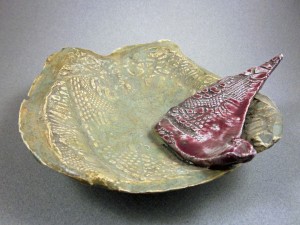
This footed soft slab textured dish shows a generous willingness to let the clay be clay, but not much finishing technique. The edges and that point are really sharp! And the piece rocks on its foot. I made four similar pieces, cutting the imprinted slabs with a sideswipe of a rubber spatula. My painter’s experience chose nearly-complementary colors for the glazes, as well as contrasting matte and shiny finishes. I see that my attraction to duller/matte surfaces appeared at the beginning, even if I felt so utterly out of control that I let the materials direct me. (Which was not so bad of a choice as it sounds!)
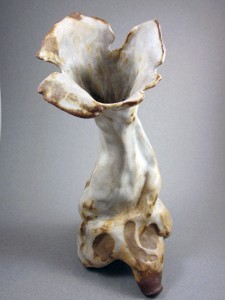
Another matte and soft-formed piece, done “After Instruction.” I still worked very wet, following the clay’s lead – and gravity’s – and did almost no adjusting, clean-up or finishing work, although the edges don’t bite and it sits steadily on its three legs. I enjoy the organic expanding gesture of this vase and the dull white stoneware glaze with the iron oxide “burnt” areas. Flowers look wonderful in it and it doesn’t leak. I still like to make my taller vase-like pieces dance!
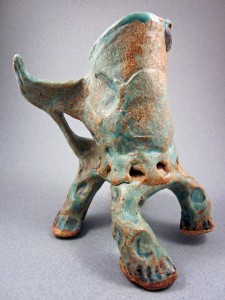
More legs! I see this Mug/Cup beginning to have real stance and gesture. The Handle-Wing is very comfortable to hold but the crudely applied leg attachments are cracking off and that one on the far right shrunk and pulled up out of the plane of the other three legs in the heatwork of the kiln. The top rim is so uneven as to not deliver beverages to the lips without dribbling. Definitely a concept piece. Love that turquoise matte glaze which is toasty where thin! I was tiring of only glazing my work and hungry for more painterly surfaces, but hadn’t a clue on how to obtain them and was flummoxed by how radically it all changed in the kiln.
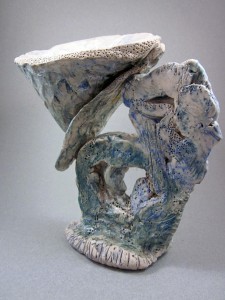
A radical attempt at pushing the sculptural vessel envelope in 12″ tall concept goblet which is more about form than function and proud of it. I was still letting the clay be its lumpy self, and attaching things by glazing them together. That cone shape is barely touching the flattened support and I don’t quite know how it stayed in place. I see some poked in stippling texture at the rim and a lot of drawing with underglaze chalks and pencils before sponging on the clear glaze. A daring piece which I could have never replicated….and really didn’t want to, but I was getting away from relying on glazes at last.
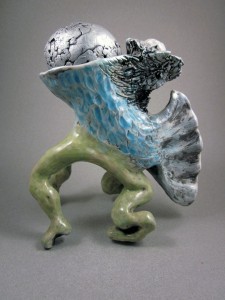
A few years later, I’ve got some command of my forms….up to a point. I still work the clay when it is too wet, counting myself lucky to fashion the shapes I do before it all dries. The idea of managing and slowing my drying is still exotic to me. Notice the roughly unfinished and caving legs. By this time I’ve discovered underglazes, especially the Duncan Concepts and Mayco Stroke ‘n’ Coats which have paint-like colors, even if they are too shiny for me. Add the silver ‘cold finish’ Rub ‘n’ Buff colored wax and you’ve got “It Came From the Sea.” This was the seminal piece for a series of 20 I developed, all on legs, all with improbable animal bodies and round hollow rattle stoppers. I called them QZRs, for Quadrupedal Zoomorphic Rattleheads. They were heavy and crudely finished, but full of heart and intention and love of the medium…and they were my original invention.
What I’m taking away from these very early pieces is an appreciation for my willingness to mess around and see what happened and then make some aesthetic decisions. That investigative spirit led me to repeatedly try nearly every technique for forming and finishing I encountered, as many times as they were presented. I read avidly, clipped articles, took classes and workshops. I often heard the same instruction and explanations with new ears and a new mind, full of wonder each time. I made all kinds of errors. I learned to throw and found I was faster working by hand and that I tended to alter my thrown pieces so completely it was pointless to start with something perfectly round. I had a decided preference for sculptural over functional, narrative over reporting.
I still persisted in working the clay too wet and then letting it get away from me, though. I did not learn for at least another five years how to maintain dampness, selectively re-wet, do the right moves at the relatively optimum state of dryness, work in pieces and attach them or how to reclaim totally dried out clay. That did not really stand in my way because I was fascinated with the work at hand and there was always plenty to learn about that. Even now, the spirit of exploration accompanies me as a permanent partner in creativity.
I also see a sense of humor in these forms, a certain verve or brio that I never want to lose. It’s good to look back and intentionally catch and preserve what matters in the long arc.
Part II will expand on my early adventures in surface decorating.
~Liz Crain is a ceramic artist and has been for longer than she thought.

 Last week my ceramics compatriot Karen Hansen posted about a workshop we recently attended. She titled her post